| L’architettura dipende | Bologna, Italy | Unit 21 | 2026 |
| Architecture Depends begins with Jeremy Till’s argument that architecture is fundamentally contingent: shaped not only by the architect, but by forces outside direct control — people, occupation, regulation, climate, institutional systems, memory, construction, and repair. Rather than treating this dependency as a weakness, the project uses AI as a method to expose and work with it. The research starts with a controlled bedroom experiment, where a large language model is asked to place personal objects into a familiar room. Through repeated tests, the project observes how AI makes spatial decisions, how previous prompts influence later outputs, and how references can shift arrangement into architectural transformation. What first appears as misreading becomes a way of revealing hidden assumptions within representation, context, and design intention. The project then moves to Bologna, a city where historical knowledge, public life, and advanced computation coexist. The portico system is studied as a continuous urban route made from individual architectural fragments. The unpacking of the Archiginnasio Library introduces questions of institutional memory and alternative forms of repair. Fragments of street façades, porticos, and library interiors are extracted, reimagined, and recombined into a design dataset through a trained AI agent. The project proposes a public library and conservation institute in Bologna’s university district. Developed through a co-working process between human judgement, AI suggestions, specialist feedback, and site constraints, it tests how architecture might emerge from dependency rather than deny it. |
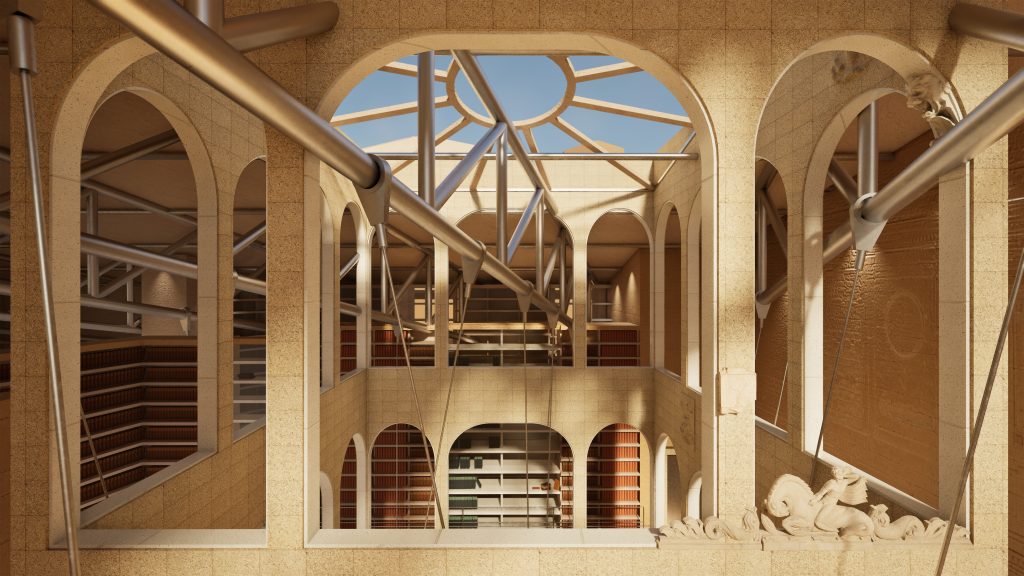
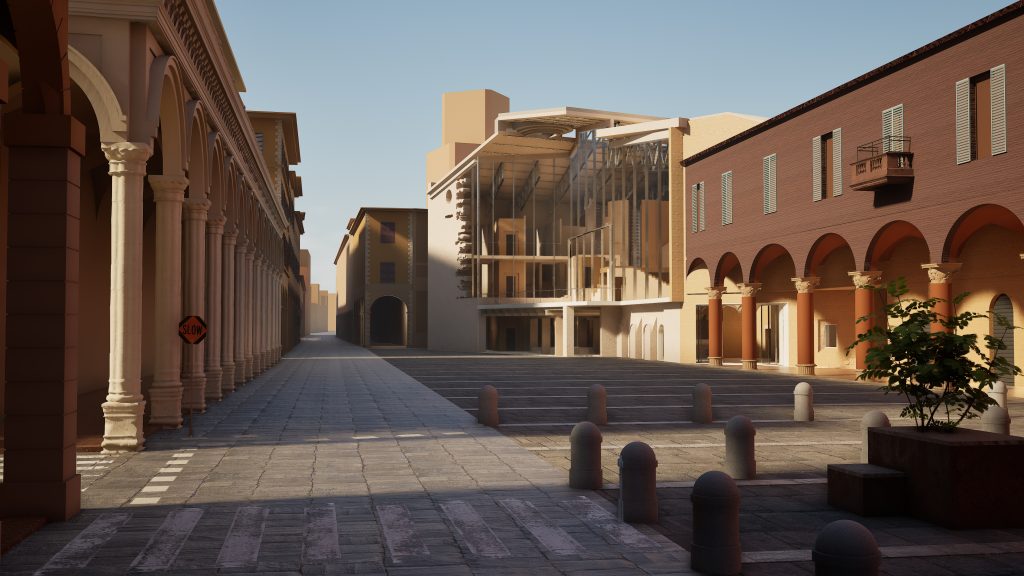
Portico, Library, and Public Threshold The proposal presents a public library and conservation institute facing Piazza Giuseppe Verdi. Its exposed interior, portico edge, amphitheatre, library, and workshop make the building read like a sectional model open to the city. |
From Room Experiment to Bologna Dataset This process video traces the project’s method: beginning with AI object-placement tests in my bedroom, then expanding to Bologna through portico routes, street façade extraction, and Archiginnasio fragments to build a trained design dataset. |
Applying Multi-Agent Iteration to Building Design The accumulated dataset is applied to the site through a co-working process between AI suggestion and human judgement. Portico rhythm, structure, amphitheatre, library, roof, fire strategy, and environmental performance are tested and adjusted together. |
Architecture Depends: Process Film |